Hold, allocate, and move balances across USD, GBP, EUR, and CAD from a single platform built for money movement.
.png)
Use virtual and correspondent accounts to collect funds, manage balances, and route money across products, partners, and payout paths.
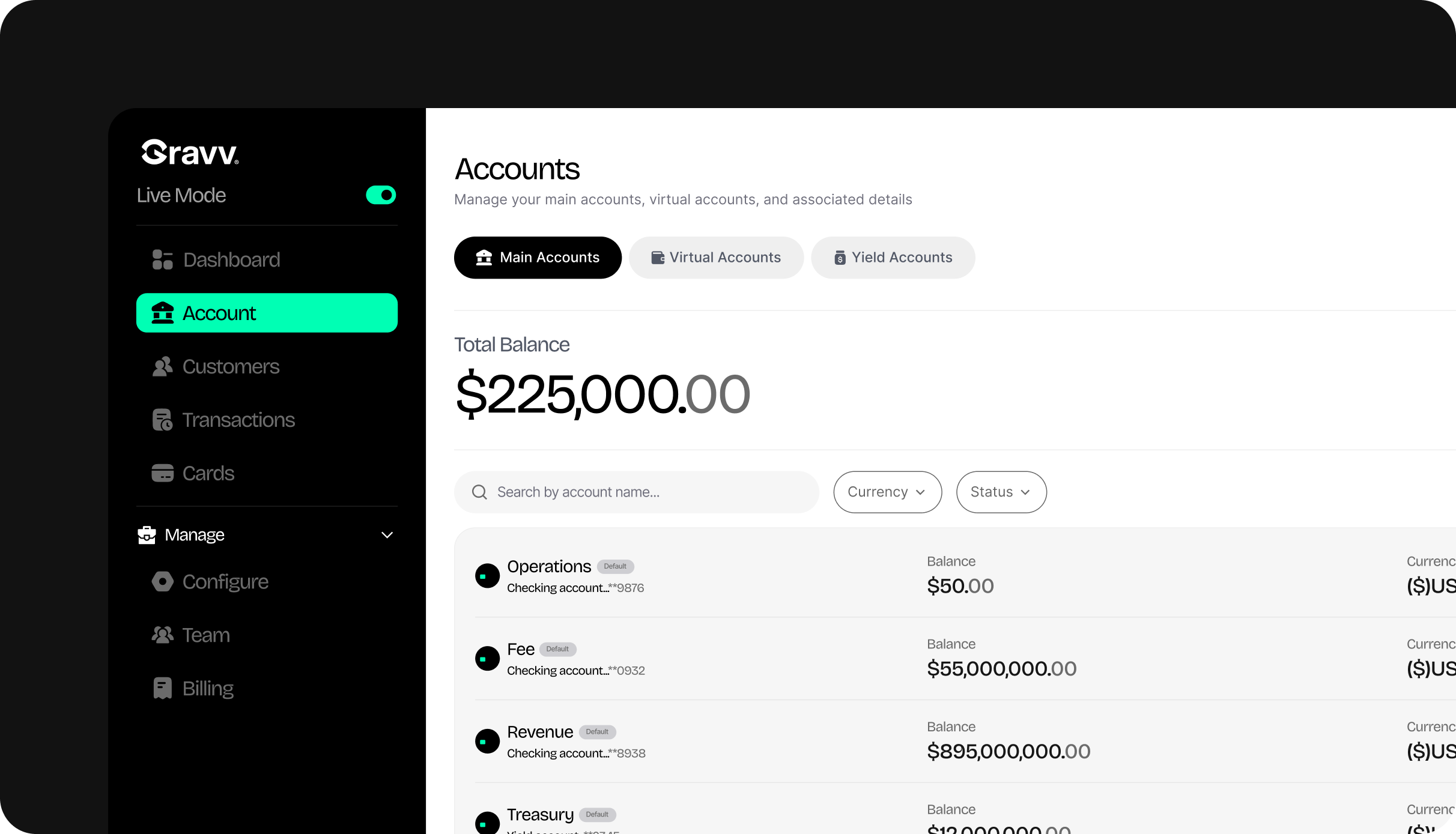
Maintain multiple internal accounts to separate activity without splitting systems.
Explore Accounts.png)
.png)
Receive Through Multiple Channels
Virtual IBANs, cards, Apple Pay, Google Pay, wallet addresses. Different entry points, same underlying balance.
.svg)
Separate Customer Funds from Business Activity
Customer balances stay attributable. Business accounts support treasury, operations, and product flows.
Support Different Holding Patterns
Active transactional balances and longer-term holds. Clear distinction at the infrastructure level.
Accounts as Product Logic
Limits, card access, payout behavior, and reporting tied to where funds are held and how they're classified.
.png)
Maintain a detailed and easily accessible record of all team interactions with our comprehensive conversation history.
.svg)
Handle active movement of funds across your product: deposits, withdrawals, and payments where liquidity and flexibility matter.

Interest accrual on eligible balances with intentional constraints for disciplined capital allocation
.png)
.png)
A single card account serves as the underlying balance for every customer card.
Straight answers to what matters before you integrate.
Many teams create separate main accounts per product line, feature, or operational flow. This keeps balances and activity attributable without introducing separate systems or integrations.
Main accounts belong to your business and are used to manage operational funds such as revenue, payouts, card-backed balances, or longer-term holdings. Customer accounts belong to your users and reflect money they send, receive, or hold through your product. Keeping these separate helps maintain clarity around ownership and activity.
No. Each account maintains its own balance. Funds only move between accounts through explicit transfers, which keeps ownership and intent clear.
Teams often use dedicated main accounts for fees or revenue. Incoming funds can be routed or allocated internally so fee-related balances remain distinct from customer or operational funds
Because every balance change is tied to a recorded movement, reconciliation becomes a matter of reviewing activity rather than reconstructing it. This applies to both customer accounts and business accounts.
Yes. While the account model remains consistent, teams can apply region-specific rules or flows around accounts without changing the underlying structure.
Outgoing transfers always reference a specific source account. This keeps it clear where funds originated and ensures balances reflect outgoing activity accurately.
Multi-currency accounts with compliance tooling, fund segregation, and operational visibility.
